
A Price You Can Read Line By Line
Tear-off, insulation, membrane, flashing, and access each get their own line, so you can see why the number is what it is and compare scopes fairly.
Serving Sergeant Bluff, IA
We are a Sergeant Bluff commercial roofing contractor pricing new TPO, EPDM, and metal roofs from core cuts and a measured roof walk.

Sergeant Bluff commercial roofing cost starts with square footage, then moves with what we find under the membrane. Two buildings the same size can price far apart once the core cuts come back.
We measure every roof section, count the layers coming off, and mark wet insulation on a plan. Your written price lists each of those lines, so you can see which one moves the total.
Each of these shows up on the roof walk and changes the scope, and the price with it.
An earlier recover left an old membrane under the current one, which doubles the tear-off.
Price both layers off, then check the deck for rust before new insulation goes down.
Saturated insulation crushes under foot traffic and holds water against the deck.
Mark the wet area from core cuts and price replacement boards for that area only.
Each curb, boot, and support needs its own flashing work, which adds labor per piece.
Count every penetration on the roof plan so the flashing line in the price is exact.
Wind works old coping and gravel stop loose, and water gets in behind the flashing.
Replace edge metal and coping along with the membrane so the perimeter is sealed.
A clear scope up front changes how the job goes. These are the gains from pricing a roof this way.
Tear-off, insulation, membrane, flashing, and access each get their own line, so you can see why the number is what it is and compare scopes fairly.
Core cuts taken before pricing show the wet boards and hidden layers ahead of time, so the scope matches the roof once it comes apart.
Replacement is when insulation thickness gets set, and the scope names it, so the new roof meets the energy code and holds heat in winter.
Knowing the roof scope early lets the job land in warmer months, when adhesives cure on schedule and tear-off sections can run larger.
After square footage, the system is the biggest line in a price. These are the four we install.
White welded membrane prices well on big, simple roofs with few penetrations, since wide rolls cover ground quickly.
Rubber fits freezer space and tall walls. Fully adhered sheets add adhesive and labor compared with attached systems.
Shops and storage buildings with purlins take metal panels, and retrofit framing over an old roof can remove tear-off costs.
Industrial buildings get a price per roof area, since exhaust, traffic, and equipment change the system from one section to the next.
Lay them side by side and check layers, insulation thickness, and flashing. Call us and we will walk you through what each line covers.
From the first call to the final walk, five steps tie the price to the roof.
We measure each roof section, take core cuts across the field, count penetrations, and photograph edges, drains, and curbs for the written scope.
Tear-off, insulation, membrane, flashing, edge metal, and access are priced separately, along with a unit price for any extra wet boards found during the work.
Before scheduling, we check the roof permit the building needs with the city of Sergeant Bluff and add any inspection steps to the plan.
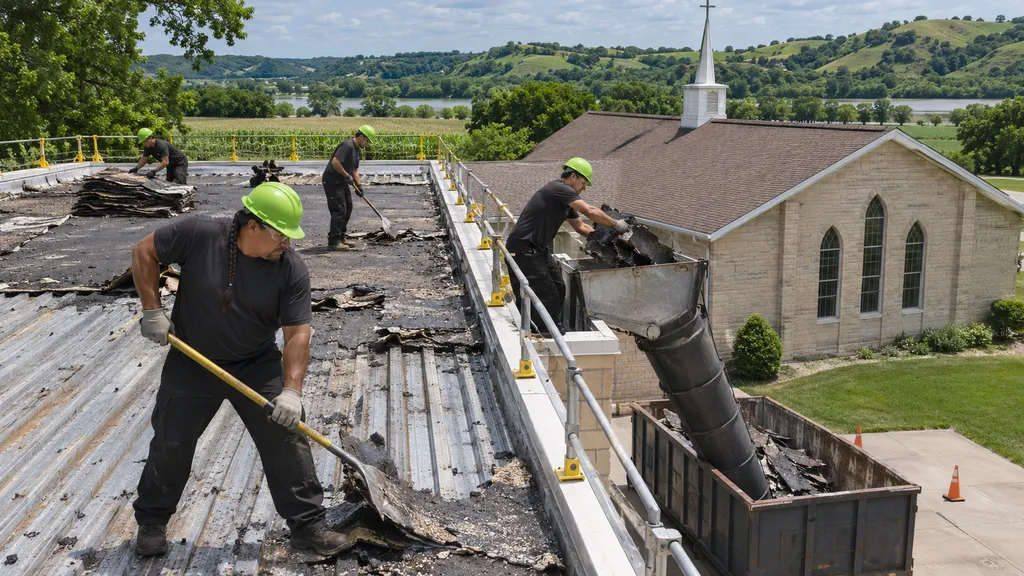
Each day of work covers one section: off to the deck, new insulation and membrane, and sealed before the roof is left for the night.
Together we walk the finished roof, confirm every line in the scope was done, and go over the manufacturer paperwork for the system.
Beyond Sergeant Bluff, we replace commercial roofs in Sioux City and four more towns nearby.
Not on the list? Call us or send us a message.
Answers about pricing and planning a roof in Sergeant Bluff.
Roof size, the system, how many layers come off, and the insulation the new roof needs. Wet boards found at tear-off add material and labor, and roof height, crane access, and rooftop units change staging time. We also check the local permit with the city before the job is scheduled.
A square-foot figure blends tear-off, insulation, membrane, and flashing into one number, so it shifts with every roof. Simple, open roofs with one layer land low; small roofs crowded with units and two layers to remove land high. Your written scope breaks the total into lines instead.
Look for one who takes core cuts before pricing and puts the scope in writing. Ask for Iowa contractor registration, compare insulation thickness and flashing line by line, and check what happens if more wet insulation turns up. We work in Sergeant Bluff and the towns around it.
Up front, yes, because less comes off the roof. A recover only works when the existing insulation is dry and the code allows another layer, which core cuts and the city check confirm. When the old roof is wet, covering it traps the water and shortens the life of the new one.
Usually, because setup, staging, and crane time spread across more area. Edges and penetrations also make up a smaller share of a big roof. A small roof with many units can price higher per foot than a large, open warehouse.
Send the building address and roof size if you know it. We take core cuts and send a price you can read line by line.